




Dhokra Art: History, Casting Process and Dokra Metal Handicrafts
• By Richa Kumari
• 2026-01-02
• 13 mins read
Dhokra art is a traditional metal craft made using the ancient lost-wax casting technique, where each object is shaped by hand and cast only once. In simple terms, it is a method of creating metal sculptures and objects using clay moulds and wax models, resulting in pieces that can never be exactly replicated. This is what gives Dhokra its raw texture, uneven finish and unmistakable handmade character.
The terms Dhokra and Dokra are often used interchangeably and refer to the same craft tradition. Both describe metal objects made using the lost-wax process by tribal artisans. Sometimes the term “Dhokra art painting” is also used, but this usually refers to paintings inspired by Dhokra motifs, not the actual metal craft. True Dhokra art always involves metal casting, not paint or flat surfaces.
History of Dhokra Art in India
The history of Dhokra art goes back more than four thousand years, making it one of the oldest known metal casting traditions in the world. Archaeological evidence suggests that similar casting techniques were used during the Indus Valley Civilisation. The famous Dancing Girl sculpture from Mohenjo-daro is often cited as proof of early lost-wax metal craftsmanship in the Indian subcontinent.
What makes Dhokra art remarkable is that it survived without written manuals or formal documentation. The knowledge of casting was preserved entirely through oral tradition. Skills were passed from one generation to the next by observation and practice. Despite political changes, industrialisation and modern manufacturing, Dhokra continued to exist within tribal communities who treated the craft as part of daily life rather than commercial production.
Dokra Metal Craft: Where and How It Originated
Dokra metal craft originated among nomadic and semi-nomadic tribal communities who travelled across central and eastern India. These groups carried their tools, materials and knowledge with them, setting up temporary workshops wherever they settled. The craft was never tied to a single city or court, which allowed it to evolve organically.
For these communities, Dokra was not created as decoration alone. Objects were made for rituals, worship, protection and storytelling. Figurines represented ancestors, animals symbolised survival and strength, and everyday objects carried cultural meaning. This deep connection between craft and life is why Dokra art feels grounded and expressive even today.
Regions That Practice Dhokra Art in India
Dhokra art is practised across several regions in India, each adding subtle visual and thematic differences to the craft.
In Bastar, Chhattisgarh, Dhokra figures are bold, heavy and deeply textured. They often depict tribal life, animals and musicians. Odisha’s Dhokra work tends to be slightly more refined, with smoother surfaces and balanced proportions. In Jharkhand, artisans focus on storytelling through human figures and community scenes, while West Bengal’s Dokra is known for its cleaner silhouettes and decorative appeal.
These regional differences are not rigid styles but natural outcomes of local culture, materials and artisan preference.
Materials Used in Dhokra Metal Craft
The materials used in Dhokra art are entirely natural, and each plays a crucial role in the final outcome. The choice of materials directly affects texture, weight and durability.
- Clay, Soil and Rice Husk Mixture
The base mould is created using a mixture of local clay, soil and rice husk. This combination provides strength while allowing air to escape during firing. The rice husk burns away during heating, creating space inside the mould for molten metal.
- Beeswax and Natural Resins
Beeswax is used to model the detailed surface of the sculpture. Artisans shape every line, dot and texture by hand using wax. Natural resins may be mixed with the wax to adjust flexibility depending on weather conditions.
- Metals Used in Dhokra Casting
Dhokra is usually cast in brass or brass alloys. The metal choice gives the craft its warm, earthy tone and long-lasting strength. Exact compositions vary by region and availability.
- Plant Materials and Traditional Tools
Leaves, fibres and simple hand tools are used throughout the process. Tools are often handmade and adapted by artisans over time, reflecting personal working styles.
Dhokra Casting Explained: The Lost Wax Technique
The lost-wax technique is the heart of Dhokra casting. In this method, a wax model is created first, then covered with layers of clay to form a mould. When the mould is heated, the wax melts and drains out, leaving a hollow space inside.
Molten metal is poured into this cavity, taking the exact shape of the wax model. Once the metal cools, the clay mould is broken open. Because the mould is destroyed in the process, it can never be reused. This is why every Dhokra piece is completely unique, even if the same design is attempted again.
Step-by-Step Dhokra Casting Process
- Preparing the Clay Core
The process begins by shaping a rough clay core that defines the basic form of the object. This core acts as the internal structure.
- Wax Modelling and Surface Detailing
Wax is applied over the clay core and carefully shaped by hand. Every detail is added at this stage, from facial features to decorative textures.
- Creating the Outer Clay Mould
The wax-covered model is layered with fine clay to form a strong outer mould. Small channels are added to allow wax to escape and metal to flow in.
- Firing the Clay and Melting the Wax
The mould is fired in a kiln or open furnace. Heat hardens the clay and melts the wax, which drains out completely.
- Pouring Molten Brass into the Cavity
Molten metal is poured into the hollow mould. This step requires precision and experience, as temperature and timing are critical.
- Cooling, Breaking the Mould and Finishing
After cooling, the mould is broken open to reveal the metal form. The piece is cleaned, polished and sometimes lightly hammered to enhance texture.
Dhokra Sculpture: Forms, Motifs and Craft Identity
Dhokra sculptures are instantly recognisable for their raw form, textured surfaces and simplified proportions. These characteristics are intentional and central to the craft’s identity.
Human figurines are among the most common forms. They are often depicted:
- Standing upright
- Playing musical instruments
- Dancing or engaged in everyday activities
These figures are not designed to look realistic. Their elongated limbs and stylised facial features focus on expression and movement rather than anatomical accuracy.
Animal forms are equally significant in Dhokra sculpture. Common motifs include:
- Elephants
- Horses
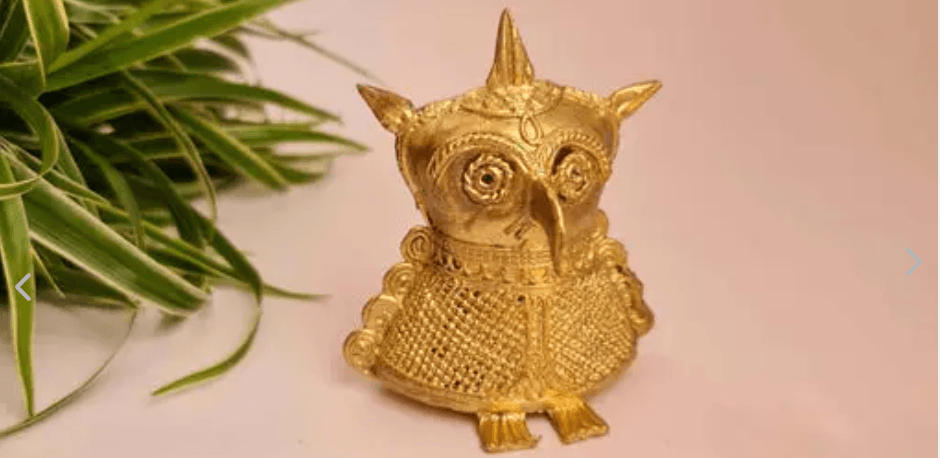
- Owls
- Bulls and birds
Each animal reflects aspects of tribal life, nature and belief systems, as seen in motifs like the Dhokra Owl Sculpture, which symbolises wisdom and protection. Deities and ritual objects are also cast using the same method, typically with minimal detailing and symbolic postures. While the proportions may appear primitive, this is a deliberate artistic choice rooted in storytelling and spiritual meaning, not a limitation of skill.
Themes and Symbolism in Dhokra Art
Dhokra art is deeply shaped by the everyday environment of the artisan. Scenes of work and celebration are commonly expressed through group figurines that show musicians, farmers and dancers in motion. These compositions highlight collective life rather than individual identity.
Beyond daily life, Dhokra objects often serve a functional role within traditions. Certain pieces are created specifically for household rituals, seasonal ceremonies or community offerings. While many Dhokra artworks today are displayed as decor, their original purpose was rooted in use and cultural practice, not ornamentation alone.
Dhokra Handicraft Products Commonly Made Today
Over time, the range of Dhokra handicraft products has expanded while staying true to traditional forms.
God Idols and Ritual Objects
These include small idols, lamps and sacred symbols used in home temples or during ceremonies, such as the Ganesha Dhokra Showpiece. They are usually compact, heavy and rich in texture.
Human Figurines and Tribal Scenes
These pieces often depict daily life, music and dance. They are valued for their storytelling quality and cultural depth.
Utility and Home Decor Objects
Bowls, candle holders and decorative containers are also made using the Dhokra technique, blending function with art.
Animal and Bird Figurines
Elephants, owls and horses are popular choices for home décor, with symbolic meanings like wisdom, strength and protection as seen in the Bankura Dhokra Horse.
Dhokra Art Painting vs Dhokra Metal Craft
The term “Dhokra art painting” can be misleading. It usually refers to paintings or wall art inspired by Dhokra motifs, colours and forms. These are flat, painted works and do not involve metal casting.
The actual Dhokra metal craft is three-dimensional and created using the lost-wax process. The two are connected visually, but they are fundamentally different in technique, material and craftsmanship. Understanding this difference helps buyers know exactly what they are purchasing.
How to Identify Authentic Dhokra Metal Handicrafts?
Authentic Dhokra pieces have a noticeable weight due to solid metal casting. The surface is uneven, with small pits, lines and textures that indicate hand finishing. No two pieces will look exactly alike, even when they depict the same form.
Look closely at the joints and detailing. Hand-cast metal often shows slight variations and organic edges. Machine-made replicas tend to be smoother and more uniform. Authentic pieces also feel warm and grounded, rather than polished or glossy.
Why Every Dhokra Piece Is One of a Kind?
Every Dhokra piece is unique because the mould used to cast it is destroyed during the process. Once the metal is poured and cooled, the clay shell is broken open and discarded. This means the same mould can never be reused.
Additionally, wax detailing is done by hand each time. Fire, temperature and metal flow also introduce natural variation. These factors ensure that even if an artisan attempts to recreate the same design, the outcome will always differ slightly.
Dhokra Art in Contemporary Homes and Design
Dhokra art fits beautifully into modern homes because of its earthy tones and sculptural quality. In minimalist interiors, a single Dhokra figurine can act as a strong statement piece. In eclectic spaces, multiple objects can be layered to create visual interest.
Designers often use Dhokra pieces on console tables, shelves or as focal decor in living rooms. Their neutral metal finish works well with wood, stone and natural fabrics, allowing traditional craft to blend seamlessly with contemporary design.
Challenges Faced by Dhokra Artisans Today
Dhokra artisans face significant challenges despite growing interest in handmade decor. The casting process is time-intensive and physically demanding, yet market prices often fail to reflect this effort. Cheaper imitations made using moulds and machines further reduce demand for authentic work.
Another challenge is skill continuity. Younger generations are often reluctant to enter the craft due to unstable income. Without sustained support and fair valuation, this ancient tradition risks gradual decline.
Why Dhokra Art Still Holds Timeless Value?
Dhokra art endures because it represents continuity, sustainability and human expression. The craft uses natural materials, minimal machinery and deeply embedded knowledge. Its imperfections are not flaws but markers of authenticity.
In a world dominated by identical products, Dhokra offers something rare. Each piece carries the imprint of the artisan, the unpredictability of fire and the weight of history. This combination gives Dhokra its timeless appeal.


Dhokra Metal Handmade Owl Showpiece| H- 3.5 inches x W- 2.5 inches| Brass

Handcrafted Dhokra Art Bankura Horse Figurine | Traditional Tribal Metal Sculpture | L- 6 inches x H- 3 inches

Dhokra Metal Handmade Harappan Dancing Girl Replica Statue Showpiece - 7x2.25 inches / Brass

Dhokra Metal Handmade Leaf Tealight Holder Showpiece (Set of 2) - 16.8 x 6.5 cms / Brass

Ganesha Showpiece Handmade in Metal | Dhokra Craft - H - 7 inches X W - 2.5 inches / Brass
You May also Like
Benefits of Choosing Eco-Friendly Home Decor
• By Anamika
• 2026-01-07
Why choose Handmade Products over Mass-Produced Products
• By Anamika
• 2026-01-07
Lippan Art vs Other Indian Wall Arts: Key Differences & Which Is Best for Your Home
• By Richa Kumari
• 2026-01-02
How to Choose the Right Lippan Art Size for Your Wall | Expert Sizing Guide
• By Richa Kumari
• 2026-01-02
How to Select the Right Bedsheet for Summer, Winter & Monsoon
• By Richa Kumari
• 2026-01-02
Frequently Asked Questions
What metal is used in Dhokra art?
Dhokra is usually made from brass or brass alloys.
Why does Dhokra art look uneven?
The uneven texture comes from hand modelling, clay moulds and the lost-wax casting process.
Is Dhokra art heavy?
Yes. Authentic Dhokra pieces are solid and heavier than decorative replicas.
Can Dhokra art be used outdoors?
It can be placed in covered outdoor areas, but prolonged exposure to moisture may affect the surface.
Are all Dhokra pieces handmade?
Authentic Dhokra art is fully handmade. Machine-made versions lack the same texture and uniqueness.
 Free DeliveryAcross India
 100%Hand-crafted
 COD Available
 Easy Returns